

Ultimate Analysis of the 2026 World Cup 48 Teams: Mbappe and Haaland in Group I, Messi and Ronaldo Could Face Off in the Quarterfinals
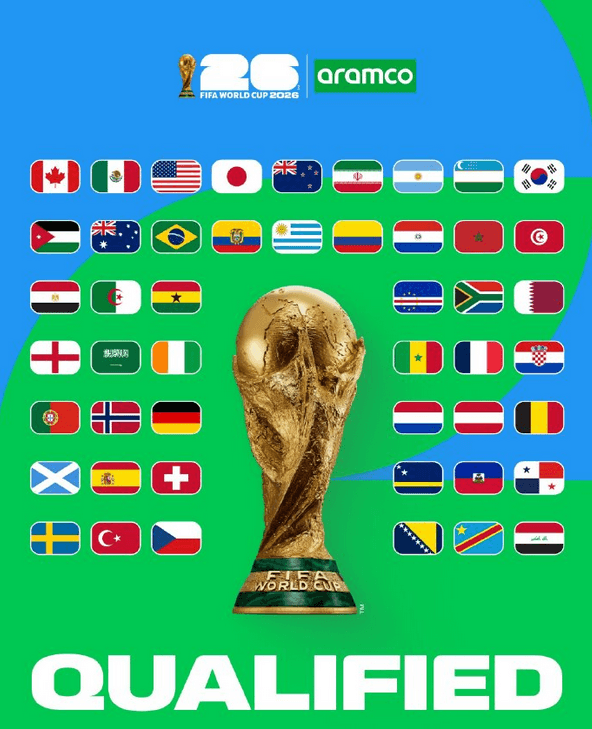
With only two days remaining until the opening match at the Azteca Stadium in Mexico City at 3:00 AM Beijing time on June 12th, the 2026 USA-Canadian World Cup is about to kick off. This tournament, for the first time, expands to 48 teams, with a total of 104 matches spanning 39 days. The champion needs to win eight consecutive matches – making it the longest and most grueling endurance test in World Cup history. With the final 48 teams confirmed and the 12 groups drawn, a football extravaganza spanning North America is about to begin.
However, just 48 hours before the match, undercurrents are still swirling outside the tournament. Iran's World Cup-exclusive ticket quota for fans was temporarily withdrawn by the United States, many Moroccan fans were unable to attend due to visa denials, and even FIFA referees were denied entry to the United States. "Football and politics," "veterans and new champions" intertwine to create the most unique pre-tournament scene of the 2026 World Cup.
I. Group Stage Draw: Smooth Paths for Giants vs. Hidden Dangers for Dark Horses
This draw ensured that the world's top four teams—Spain, Argentina, France, and England—were placed in different semi-final paths. This World Cup saw a historic change in the qualification process—the top two teams from each group advance directly, while the eight best third-placed teams from the 12 groups advance to the final 32. This format provides more leeway for the elite teams, but also makes every group stage match crucial.
The following is the complete group draw for the 12 groups:
Group A: Mexico, South Africa, South Korea, Czech Republic
Group B: Canada, Bosnia and Herzegovina, Qatar, Switzerland
Group C: Brazil, Morocco, Haiti, Scotland
Group D: USA, Paraguay, Australia, Turkey
Group E: Germany, Curaçao, Ivory Coast, Ecuador
Group F: Netherlands, Japan, Sweden, Tunisia
Group G: Belgium, Egypt, Iran, New Zealand
Group H: Spain, Cape Verde, Saudi Arabia, Uruguay
Group I: France, Senegal, Iraq, Norway
Group J: Argentina, Algeria, Austria, Jordan
Group K: Portugal, Democratic Republic of Congo, Uzbekistan, Colombia
Group L: England, Croatia, Ghana, Panama
Looking at the qualification situation, the groups containing Spain, Argentina, and England have relatively weak opponents, almost guaranteeing them the top spot in their groups. In Group H, Spain is grouped with Cape Verde, Saudi Arabia, and Uruguay. Cape Verde is a newcomer to the World Cup finals, while Saudi Arabia has a long history of poor performance in international competitions. Uruguay, despite boasting stars like Núñez and Araujo, is clearly outmatched by the Spanish national team. Spain's opening group stage match against newcomers Cape Verde is only theoretically possible, and the increasingly difficult schedule gives coach De la Fuente ample room for error.
Defending champions Argentina are in Group J, with Algeria, Austria, and Jordan facing relatively weak opponents. Jordan, another World Cup newcomer, is almost certain to advance.
Group I is the most intriguing group of the group stage – the clash between two generations of strikers, Mbappé and Haaland, promises to be a highly anticipated "new kings' duel." France appears stronger on paper, but Haaland's Norway, returning to the World Cup after 28 years, is no pushover. Their impressive 16-goal haul and double victory over four-time champions Italy in the qualifiers demonstrate their ability to disrupt the competition.
Group L, with England, Croatia, Ghana, and Panama, is the most balanced group overall. Modric's Croatia, though veterans, remain formidable; Ghana's physicality and attacking prowess are enough to pressure any defense; England's star-studded attack may seem superior on paper, but securing the top spot in the group will be far from easy.
A dark horse to watch: Japan, having defeated Germany and Spain in the previous tournament, has proven its technical style and team discipline in numerous major competitions. Grouped with the Netherlands, Sweden, and Tunisia in Group F, advancing is certainly not impossible. Cape Verde, Jordan, Uzbekistan, and Curaçao, all newcomers, will write the most glorious chapters in their respective national football history.
II. Twilight of the Gods: Legendary Stars Embark on Their Final Farewell The most moving moment of this World Cup is undoubtedly the "last dance" of legends like Messi and Ronaldo. At 38 years old, Messi, making his sixth World Cup appearance, is the undisputed pillar of the Argentine team. Despite suffering a left hamstring injury during an international match in Miami at the end of May and currently undergoing individual physical training to recover, Argentina coach Scaloni has repeatedly emphasized that Messi's injury will not affect his World Cup appearance – he will be fit for the opening group stage match. With 26 World Cup appearances, a record in history, and 13 goals, just 3 shy of Klose's record of 16, this will be his final performance on the World Cup stage.
41-year-old Cristiano Ronaldo will be making his sixth World Cup appearance, becoming the first player to participate in six World Cups. He remains fully committed in training, posting training photos on social media with the caption "Preparing step by step," showing fans the veteran's unwavering fighting spirit. With Leao, Bernardo Silva, and Bruno Fernandes in their prime, and Diaz and Inácio anchoring the defense, Ronaldo's task is singular – to close out the game. This World Cup presents him with his final chance to break his embarrassing record of 0 goals and 0 assists in 8 knockout stage matches. If he can overcome this mental hurdle in North America, Portugal will be one step closer to the trophy.
Neymar is embarking on his fourth World Cup journey, which is also highly likely to be the final for the Seleção's number 10. Although Neymar is still recovering from a grade 2 right calf injury and is expected to miss the opening match against Morocco, his recovery is progressing well. He is following the recovery and fitness plan devised by the Brazilian national team's medical staff and may return for the second group stage match.
Modric (40 years old, sixth World Cup): He led his team to the final in 2018 and won third place in 2022. 2026 will be the ultimate farewell for the Croatian national team. At 40, he can still be the midfield engine of the World Cup – almost unimaginable in modern football.
Ochoa (Mexico, 40 years old, sixth World Cup): He debuted at 21 in 2006 and is still playing at 40, guarding the host nation's goal in the opening match.
III. The New King Ascends the Throne: The Post-2000 Generation Takes Over As the legendary figures fade into the distance, a new generation of leaders has quietly stepped onto the center stage.
Mbappe (26 years old, arguably the world's best): 12 goals in 14 World Cup appearances, an astonishing efficiency. In France's pre-tournament friendly, they defeated Northern Ireland 3-1, with Bayern winger Olise scoring a hat-trick. Although Mbappe didn't score, both Deschamps and Mbappe himself stated, "I'll save my best form for the World Cup, no problem." Wenger publicly supported Mbappe, saying he was in excellent physical condition, not overly fatigued, and possessed all the qualities to shine in the World Cup.
Haaland (25 years old, World Cup debut): 16 goals in the World Cup qualifiers helped Norway return to the World Cup, described by coach Solbakken as a "friendly superstar without any superstar airs." Despite only touching the ball 4 times in a friendly against Morocco due to targeted marking, the Norwegian coach clearly stated that Haaland was holding back and would unleash his full potential in the World Cup. The direct confrontation between Group I and France's Mbappe will be the most exciting individual clash of the tournament.
Yamaal (18 years old, world's most valuable player): This Spanish prodigy, who missed six weeks due to a left hamstring injury, has reportedly been cleared by Barcelona to return for the World Cup opener against Cape Verde – a limited 15-minute appearance. De la Fuente confirmed Yamal's imminent return, and there are no other injuries in the Spanish team. Yamal's return is perfectly timed, and his explosive attack will directly impact Spain's title aspirations.
Vinicius (Brazil, 24 years old), Bellingham (England, 23 years old), Musiala (Germany, 22 years old), and other emerging core players have fully taken over.
IV. Golden Boot Race: Mbappe and Kane Lead the Way
According to the latest odds on June 10th, France captain Kylian Mbappe leads the Golden Boot race with odds of 6.50. His 8-goal victory in the previous World Cup has fueled high expectations. England captain Harry Kane follows closely with odds of 7.50. His phenomenal 61 goals for Bayern Munich this season have been almost superhuman, with relatively weak group stage opponents providing him with numerous scoring opportunities. Spanish striker Oyarzabal is third, while Norwegian center-forward Erling Haaland is fourth with odds of 15.0—although the odds seem conservative, Haaland's 55 goals in 51 appearances for the national team is enough to instill fear in any defense.
V. Knockout Stage Predictions: Messi vs. Ronaldo Could Be a Quarter-Final Showdown, France Enters "Hell Mode"
Based on the knockout stage matchups, several potential clashes in this World Cup are enough to keep football fans worldwide on the edge of their seats.
Argentina vs. Portugal – The quarterfinals could be the ultimate farewell to a "Twilight of the Gods."
If both teams top their groups and advance to the Round of 16, Messi's Argentina and Ronaldo's Portugal are highly likely to meet in the quarterfinals. That would be a clash that would bring world football to a standstill – two legends who have dominated the sport for nearly two decades, facing off for the last and only time in the World Cup knockout stages. Their encounter would not only be a battle for honor but also the final spark before the transition between two eras.
France's journey has been nothing short of "hellish." If they top Group I, they could face Germany in the Round of 16, the Netherlands in the quarterfinals, and most likely, top favorites Spain in the semifinals.
The lower half of the bracket is a battle of titans: England, Brazil, Argentina, and Portugal are likely to clash in the quarterfinals. Whoever emerges from this half will be a favorite for the semifinals.
VI. World Cup Winner Prediction + Polymarket/Kalshi Strategy: Spain Leads the Popularity Chart
With only two days left until the tournament kicks off, data from major institutions and prediction markets continues to be updated.
Latest Odds from Traditional Betting Institutions:
Spain – 5.5
France – 6.0
England – 7.5
Brazil – 9.0
Portugal – 9.0
Argentina – 10.0
Germany – 15.0
Most noteworthy is the new gameplay in the prediction market. According to the latest data, Polymarket's World Cup winner prediction market has reached approximately $2 billion in trading volume, while Kalshi, a CFTC-regulated compliant prediction platform in the US, has exceeded $100 million in similar market trading volume. According to Kalshi's latest predictions, Spain leads with an 18.5% probability of winning, followed by France at 16.8% and England at 10.9%.
Polymarket's market data shows that as of June 9th, France and Spain were tied for a 16% chance of winning the title, followed by England at 11%, Portugal at 10%, Argentina at 9%, and Brazil at 8%. More noteworthy is that Polymarket also offers hundreds of detailed prediction events—from "Can Ronaldo break his zero-goal record in the knockout stage?" to "Can Mbappe win the Golden Boot again?", and even "Can England reach the final?" and "Spain wins all their group stage matches," covering virtually every possible point of interest for fans.
Why are the probabilities in the prediction market worth paying attention to? This isn't a one-way odds system; it's the aggregated result of real-money betting by users worldwide using USDT—Spain and France leading the pack represent the votes of tens of millions of users.
VII. How to Participate: Experience the Thrill of Predicting Match Results on Polymarket and Kalshi
If you also want to experience the fun of profiting from predicting World Cup results, here's a concise beginner's guide:
Step 1: Choose a Platform. Polymarket is the world's largest decentralized prediction market, suitable for users who want to use cryptocurrency for on-chain interactions; Kalshi is a compliant prediction platform regulated by the CFTC in the US, offering the highest level of fund security, suitable for users seeking a compliant environment.
Step 2: Obtain USDT/USDC. You need USDT or USDC to deposit and participate in trading. Currently, the most cost-effective option is the KXZ channel—purchasing Binance gift cards + Gate.io gift cards through KXZ offers a significant discount on deposit amounts; 500 UU of USDT/USDC now costs only about $521 (compared to about $630 through normal channels). Compared to purchasing directly from an exchange, the gift card channel saves nearly 17% in costs. Binance gift cards support sending and receiving cryptocurrency with zero transaction fees, and after exchange, the funds are directly deposited into your Binance account and withdrawn to your Polymarket on-chain wallet. Gate.io gift cards also support both USDT and USDC, offering flexible denomination options and instant settlement.
Step 3: Start Trading. On Polymarket, select your preferred prediction event, such as "Which team will win the championship?", "Will Mbappe win the Golden Boot?", or "Messi's group stage goal tally," and buy using USDT. If the prediction is correct, the winning share will be settled at the market price. On Kalshi, you can participate in the prediction by purchasing "yes" or "no" shares—each share's transaction price corresponds to the market's perceived probability. After the final result is revealed, correct shares are settled at $1, and incorrect shares are zeroed out.
Conclusion: A generation's farewell, a generation's arrival. When 11-year-old Messi first watched the World Cup on television, he could never have imagined that one day he would compete alongside Ronaldo, Mbappe, and Haaland, dragging the wheels of football history to the end of his career. From 41-year-old Ronaldo to 18-year-old Yamal, a 23-year football story is about to write its final chapter and prelude on the pitch in the Mexican highlands.
At dawn on June 12th, Beijing time, the whistle will sound at the Aztec Stadium. A Ragnarok, a transition of power, the legacy of giants, and the meteoric rise of underdogs—this could be the most star-studded and talked-about World Cup in football history, and the perfect opportunity for you to participate through blockchain prediction markets.
Make a prediction with USDT on Polymarket or Kalshi and turn your predictions into real money—no barriers to entry, just the joy of independent thinking. 500 USDT/USDC costs approximately $521 USD, easily obtainable through Binance/Gate.io gift cards via KXZ. Savvy investors have already positioned themselves; you won't want to regret missing out until the eve of the final—with only two days until the opening match, now is the best time to capitalize on the global prediction frenzy!
KXZ Store is dedicated to delivering a fast, secure, and convenient shopping experience. We offer no-registration & express checkout, making your purchase easier than ever. As a one-stop digital service platform, we cover a wide range of gift cards and top‑up services for popular platforms to meet your diverse needs. We stand by our low-price guarantee and strict security measures, ensuring every transaction delivers exceptional value and peace of mind. Above all, we prioritize information confidentiality and privacy protection, fully safeguarding your personal data.